
Is It Selfish to Ride a Motorcycle as a Mom?
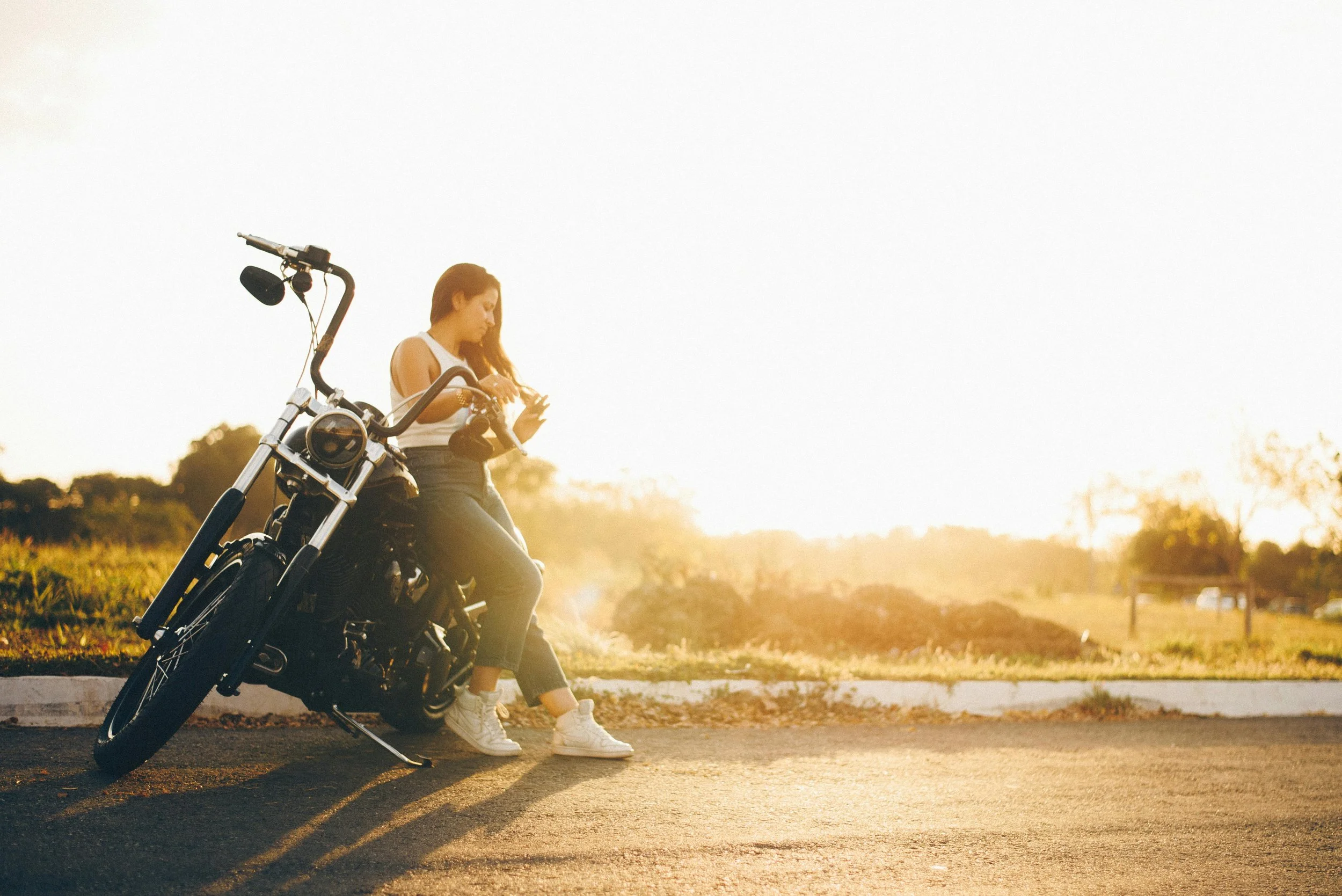
By Sam | She Shifts
You're Asking the Wrong Question.
Here's a Better One
There's a specific kind of 2 a.m. that only moms know.
Not the newborn kind — you've graduated from that particular circle of hell. This is the other one. The one where the house is quiet, nothing is technically wrong, and your brain decides that right now is the perfect time to put you on trial.
In my case, here's what this looks like:
Exhibit A: You bought a motorcycle.
Not a yoga mat. Not a Peloton. Not even a very sensible hobby like watercolor painting — ya know, something that happens in your kitchen, costs twelve dollars, and can be explained to your mother without watching her face do that thing.
A motorcycle. With an engine. That goes on roads where other vehicles are.
And now you're lying there in the dark, running the full mental spreadsheet:
Is this too risky?
Am I being completely selfish?
What if something happens to me?
What will everyone think?
Couldn't I just take up pole classes instead?
If any version of that sounds familiar — welcome. Pull up a chair. I've been saving you a seat. 😉
Hi. I'm Sam. And Apparently I’m the Mom Your Mother Warned You About.
I'm 31. I have three kids (ages 9, 8, and 6) that I homeschool and stay home with full-time.
My husband Jacob and I got pregnant at 21, after knowing each other for nine months. Got married six months before our oldest was born, and spent the next decade compressing a lifetime of growing up into the same years most of our peers were figuring out their drink orders.
We did a lot of adulting before we were adults. By our late twenties, we felt forty-five. Tired. A little haggard. The kind of "responsible" that starts to feel less like a virtue and more like a life sentence.
Then, on an otherwise unremarkable afternoon in the summer of 2025, while I was supposed to be working, I opened ChatGPT and typed something I hadn't let myself think out loud before:
"I'm drawn to the badass biker chic persona, but I'm not entirely sure how I feel about actually riding a motorcycle..."
(For context: I grew up in denim skirts, getting asked if my five younger siblings were mine by the time I was in 9th grade. "Badass biker chic" was not exactly adjacent to my origin story nor encouraged in my circle.)
I wasn't ready to commit to anything. I just wanted to let the idea breathe for a minute without someone immediately listing all the ways it was a terrible idea.
The AI said my curiosity was "legit," compared horseback riding (which I'd loved) to motorcycles as a flow-state activity, and suggested I maybe watch some YouTube videos and "vision board the version of me that rides."
Such a suggestion felt slightly unhinged and I went down the rabbit hole immediately.
One month later, we bought a 2024 Yamaha R3 off consignment at our local Harley-Davidson dealership, where it sat looking like a Teen Titans character among all those chrome Harleys in the showroom. My kids named her Dragon. (My suggestion of Beast Boi lost the vote. Whomp whomp.)
I passed my MSF course the following month, lost my income approximately one month after that, spent the next several months thinking we'd made a catastrophically irresponsible decision, and finally — this spring — rode her alone for the first time on public roads. Talk about whiplash…
Two miles up the main drag to a Food Lion parking lot, in light rain, with a cop and an ambulance cruising right next to me and the curb I almost target-fixated into on the way back. 🙃
I did not die. I did not drop the bike. I was equal parts terrified and the most alive I'd felt in years.
And yes, I still wrestle with whether I'm allowed to feel that way as a mom.
So let's talk about it.
The Voice Running the Prosecution Is Yours (Which Makes It Harder to Cross-Examine)
Here's the thing about mom guilt and motorcycle riding: usually it doesn't even show up as someone else's voice. It shows up as yours.
Nobody said anything to me when I started riding. None of my neighbors confronted me. No family member staged an intervention. (My mom and I have a polite détente where we simply... do not discuss the motorcycle.)
Here's the thing: the voice running the prosecution isn't really external. It's the one you've been practicing for years, handed down by well-meaning people who loved you and who believed, somewhere deep in the architecture of how they lived, that a good mother is a self-erasing one.
Maybe your mom stayed home and sacrificed everything, and you absorbed that as the standard.
Maybe your mom didn't stay home and she spent your childhood explaining why she should have — so now the standard lives in you anyway, imported wholesale, regardless of whether it ever actually fits.
Either way, you learned it early: motherhood and wanting something for yourself are mutually exclusive.
Which brings us to a man named Winnicott, who had some thoughts about this in the 1970s that somehow nobody put in the parenting books we were handed.
What a 1970s Psychoanalyst Knew That Your Mom Guilt Doesn't
D.W. Winnicott was a British psychoanalyst and pediatrician who introduced the concept of the "good enough mother"— a phrase that sounds like a participation trophy until you understand what he actually meant.
His argument was simple and quietly radical: your children do not need a perfect mother. They need one who is responsive enough, attuned enough, present enough — and who (critically) gradually turns back toward her own life as they grow.
That last part is what a lot of our personal examples left out, isn't it?
Winnicott wasn't just giving moms permission to be imperfect. He was arguing that a mother's gradual return to her own personhood is developmentally necessary for the child. (How ironic, right?) That a child who watches their mother reclaim herself learns something essential: that the world does not revolve around their desires. That the people they love are also full human beings. That passion is something adults are allowed to have.
In other words: your kids don't just benefit from you filling your cup. They benefit from watching you do it.
And then the neurobiologists showed up with biometric equipment and started measuring exactly what happens when you do.
What Actually Happens to Your Brain on a Motorcycle (Spoiler: Your Kids Actually Do Benefit)
In 2019, Harley-Davidson funded three researchers from UCLA's Semel Institute for Neuroscience to hook motorcyclists up to equipment measuring brain activity, cortisol, heart rate, and adrenaline — and made them ride a motorcycle, drive a car, and sit still, in that order.
The results were not subtle.
A 20-minute motorcycle ride dropped cortisol — your primary stress hormone — by 28%. Riders showed increased sensory focus and measurably improved resistance to distraction. (Girl, sign me UP for improved focus in the middle of this motherhood mayhem! 🙋🏼♀️) Also, mood improvements lasted at least ten minutes after dismounting. (Better than sex?)
The reason is interesting: riding requires such sustained, high-stakes attention to multiple inputs simultaneously — road surface, traffic, body position, throttle, brakes, the truck that just drifted into your lane — that it leaves essentially no cognitive bandwidth for rumination. Which just means that your brain is too busy doing to spiral.
But I know what you're thinking: "That sounds hella stressful! My life is already overwhelming — how could this possibly be HELPFUL??"
Psychologist Mihaly Csikszentmihalyi called this high-stakes override of your full cognitive bandwidth a flow state — complete absorption in a challenging activity that interrupts negative thinking and increases subjective wellbeing. As the saying goes: "Flow is not about pushing harder. It's about aligning with what carries you forward."
So, no, this isn't the same as multitasking with 400 tabs open in your brain at any given time. It's actually the opposite. It's your brain being fully, mercifully occupied with exactly one thing.
For a mom whose brain rarely gets to clock out — who is mentally on-call even when she's technically alone — that 28% cortisol drop isn't a perk. It's a desperately needed prescription.
And here's where it stops being just about you:
Research consistently shows that mothers' stress, anxiety, and depression are strongly linked to their children's health outcomes. Not in a vague, general way but in a measurable, documented way. Kids of depleted moms show up differently: emotionally, behaviorally, developmentally. As Katie Reed put it plainly: "Self-care is giving the world the best of you instead of what's left of you."
A mother who comes home from a ride — cortisol down, jaw unclenched, brain post-high revs, feeling like herself again — is not taking something from her children. She is bringing them back something they needed more than they needed her to sacrifice it.
Winnicott knew it in 1971. The neurobiologists are now measuring it.
Okay, But the Risk Is Real — So Let's Actually Talk About It.
Here's where I'm morally obligated to not hand you a raw-egg smoothie version of the truth, because you are a grown woman capable of handling research-backed numbers.
Motorcycle fatality data is not comforting on its face. In 2023, motorcyclists were approximately 28 times more likely to die per mile traveled than passenger car occupants, according to NHTSA. Motorcycles represent about 3% of registered vehicles but accounted for 15% of all traffic fatalities.
Those numbers are real, and I'm not going to soften them…
But risk is not randomly distributed. It clusters — and almost every cluster is around a choice.
Here's where the fatal crashes actually live:
Alcohol:Nearly 46% of all motorcyclists killed in crashes had alcohol in their system. Riders with any alcohol are about 5 times more likely to crash, and those above the legal limit face roughly 40 times the risk. That means sober riding in daylight removes you from nearly half the fatal crash population before you even start the engine.
Inexperience: New riders have crash rates 2 to 4 times higher than experienced ones, and of course the first month is the single highest-risk window.
Speed and night riding: Fatal crashes are disproportionately concentrated after dark, and night riding and alcohol risk overlap heavily. (As someone who doesn't really drink, I'm liking my odds a lot better already. 😌)
What this means for you practically: the only real cure for inexperience is time in the saddle. Not reading about riding. Not watching YouTube or BikeTok. Riding. The stats prove that risk comes down as your hours go up, and there is no shortcut around that — which means the most responsible thing a new rider can do is keep going, incrementally building the skill.
And now the number I really want you to remember:
Women make up roughly 19% of motorcycle owners — and likely closer to 25% today, given that figure is from 2018 and women have been the fastest-growing demographic in motorcycling for years. Yet women account for just 4% of motorcycle driver fatalities.
Four percent.
And women who ride their own bikes are dramatically underrepresented in fatal crash data relative to their ownership share. The research can't fully isolate every reason — women tend to ride fewer miles, at different times of day, in lower-risk conditions. But the number is what it is.
If you ride sober, in daylight, with gear, building your hours progressively? You are not making a reckless decision. You are making a calculated one, with real risk that is significantly shaped by how you manage it — and real science-backed benefits on the other side of every ride!
And just for the record: my own brother texted me after I bought the R3 to tell me the risk wasn't worth it. But his experience included a 650cc for his first bike, a custom hack job done on his second, and a track record with risk management that I will charitably describe as "colorful." He and I are not riding the same risk profile…and I refuse to let his self-assessment become my ceiling.
We Are Not the Anomaly. We Are the Trend.
Here's what the picture of women in motorcycling actually looks like, because it matters for the story you've been told about who this sport is for.
Women have gone from roughly 6% of U.S. motorcycle owners in 1990 to nearly 19% today — with projections already pointing toward 25%. Among Millennial riders — our generation — women make up 26% of motorcycle owners!
We are not the exception. We are the trend.
Women riders also complete formal motorcycle safety training at significantly higher rates than men — about 60% of women versus 44% of men. We spend more on gear. We typically approach riding as a skill to develop rather than an identity to perform.
And the top three reasons women report riding? Fun and recreation. A sense of freedom. Connection with nature and the outdoors.
Not thrill-seeking. Not ego. Effing freedom.
Now search "motorcycle content for moms" and see what you find….
A graveyard of abandoned blogs. Last posts dated 2019. Reddit threads of women whispering the same question into the dark and finding no one answering back.
That absence of a voice is part of why I'm here. I went looking for a woman like me and couldn't find her. So I became her. And She Shifts is what I'm building in that gap.
You are not alone in this. We are just early.
I Did That.
Truth be told, I was totally panicked on my first real public ride. Nauseated, honestly — that particular flavor of dread when you turn out of your neighborhood and there is no longer a quiet residential street between you and the rest of the world. 🫣
I stalled once leaving the neighborhood. I took righthand turns uphill from stoplights in traffic. I rode over speed bumps. I hit 40+ mph. And on the way back — fatigued from practicing, weaving between raindrops, with a cop and an ambulance riding right next to me — I target-fixated and nearly ate the curb. 🫠
I did not drop the bike. I did not die. And when I pulled up in front of my house and sat there for a second, the thing I thought was not I survived.
It was: I did that.
And the distinction does matter because one is relief. The other is something that doesn't have a clean name but that every woman recognizes — the specific, uncomplicated pride of doing something hard that was entirely yours. It wasn't attached to anyone else. It was something you were brave enough to do just for you.
But if I'm being totally honest... my 8-year-old is the reason I got into motorcycles in the first place. He was becoming obsessed with watching Motocross, and I was quietly terrified I'd have to form an opinion about it someday from pure ignorance.
So I decided that the type of parent I really wanted to be was the one who made an effort to understand the machines before I was asked to judge them.
He now thinks it's the coolest thing in the world that both his parents are learning to ride, and of course he wants to ride someday too. 🥰
He is watching his mom figure something out in real time. Watching her be scared and go anyway. Watching her become something she chooses for herself — risks be mitigated, but damned.
And I don't necessarily think that's a bad thing for him (or my daughters) to see.
Your Permission Slip
You've been asking: Is it selfish to ride a motorcycle as a mom?
Here's the better question: What story am I living inside and is it actually mine?
Selfish is taking without giving back.
A mother who comes home replenished, cortisol down, jaw unclenched, brain in zen mode, proud of herself — is not taking from her children. She is giving them something better than sacrifice. She is giving them a model of what it actually looks like to be a whole and complete parent.
So here, this is for you:
OFFICIAL PERMISSION SLIP
For the Moto-Curious Mom Who Has Been Asking the Wrong Question
Issued to: You — the one who's been googling this secretly during lunch, before your husband comes home, while your kids are preoccupied.
Issued by: Sam — 31, mom of three, roughly 6 months into riding, still slightly terrified, absolutely not giving it up.
You are hereby granted full and unconditional permission to:
✓ Want something that is entirely, unapologetically yours
✓ Ride a motorcycle without it being a vote cast on your parenting
✓ Be scared and go anyway
✓ Feel the specific pride of doing something hard that nobody else made or asked you to do
✓ Model for your children what it looks like to pursue something that matters to you
✓ Take up space in a sport that's been waiting for you longer than you know
✓ Give the world the best of you, instead of what's left
This slip does not expire. It does not require your mother's signature. It does not come with a waiting period.
The guilt may ride shotgun. But you go anyway.
She Shifts is a podcast, blog, and brand for women who refuse to lose themselves in the structure of their everyday lives. I'm Sam — 31, mom of three, homeschooler, stay-at-home everything, and a very new rider on a 2024 Yamaha R3 named Dragon. I didn't find the content I was looking for, so I'm building it. Come find me and the other motorcycle moms I'm meeting along the way!
→ [Listen to the podcast] | [Subscribe] | [Find us on Instagram]
Sources:NHTSA Traffic Safety Facts 2023 · NHTSA 2024 Early Estimates · IIHS Fatality Facts 2023: Motorcycles · Motorcycle Industry Council Owner Survey 2018, via IIHS · UCLA / Harley-Davidson Neurobiological Study 2019(industry-funded, preliminary) · Csikszentmihalyi — Flow and Motorcycling, The Conversation 2024 · Winnicott, Playing and Reality (1971) · Katie Reed · NIH/PMC — Maternal stress and child outcomes · NIH/PMC — Volitional solitude and maternal wellbeing · MSF Basic RiderCourse
